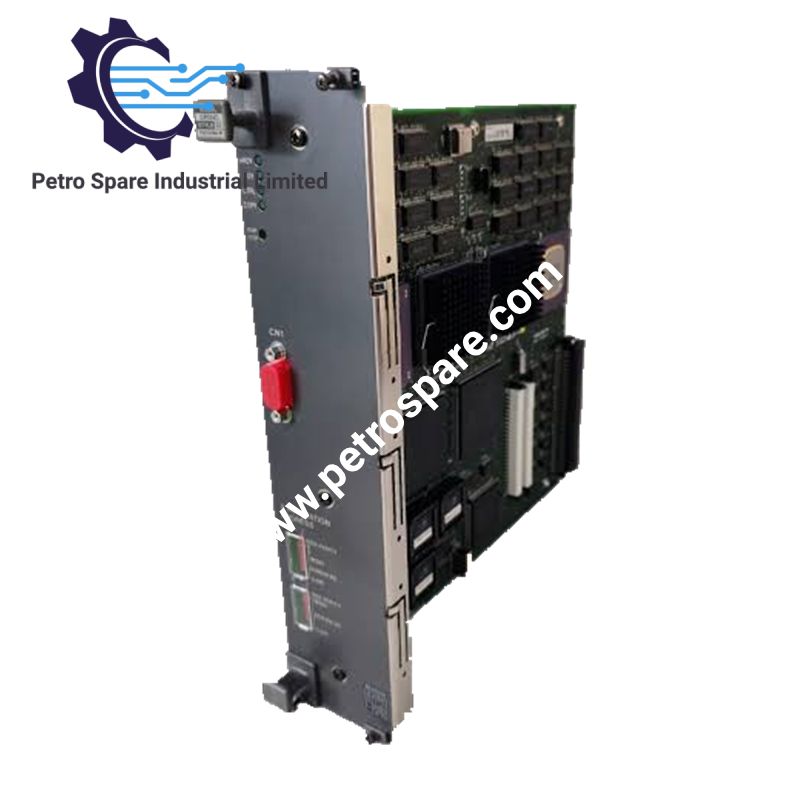


CP334D
Description
Description
The Yokogawa CP334D is a processor module used in Yokogawa CENTUM distributed control systems. It executes control operations within the Field Control Station (FCS), processing configured control logic and coordinating the operation of associated control hardware. The CP334D is identified as a 12 MB RAM processor variant, distinguishing it from the CP333D processor module listed in CENTUM CS3000 training documentation.
Function in the CENTUM Control System
The CP334D operates as the processing unit of a Field Control Unit (FCU) in the Large Field Control Station (LFCS) configuration. It performs control operations using the configured process data and control programs, coordinating communication with the station's I/O and control bus interfaces.
In a distributed control architecture, the processor executes control functions locally at the FCS level. Field input data is made available to the processor for control calculations, while resulting output data is transferred through the relevant I/O interfaces.
Memory and Processor Status
The CENTUM CS3000 training documentation identifies two processor card variants:
- CP333D: 16 MB RAM.
- CP334D: 12 MB RAM.
This memory distinction is useful when identifying replacement hardware and checking the installed processor configuration. The two models should not be treated as identical memory configurations.
Status Indicators and Diagnostics
The processor card includes four status indicators or controls documented for the LFCS configuration:
| Indicator | Function |
|---|---|
| HRDY | Indicates whether processor hardware diagnostics are normal. |
| RDY | Indicates normal hardware and software operation. |
| CTRL | Identifies the control-side processor in a duplex configuration. |
| COPY | Indicates program-copy activity between processor cards. |
The card also includes a START/STOP maintenance switch for stopping or restarting the processor CPU. CN1 is identified as a maintenance connector.
Duplex Processor Configuration
In a duplex LFCS configuration, two processor cards operate in a synchronous hot-standby arrangement. The processors perform the same control computations, and their results are compared. If an abnormal processor condition is detected, the standby processor can take over the control function.
The COPY indicator provides information about program synchronization between the control-side and standby-side processor cards. This function belongs to the configured duplex system rather than representing an independent redundancy feature of a single CP334D module.
Frequently Asked Questions
Q: What is the memory capacity of the Yokogawa CP334D?
A: The CP334D has 12 MB RAM, according to the CENTUM CS3000 training documentation. The CP333D is a separate variant with 16 MB RAM.
Q: What does the CTRL indicator show?
A: In a duplex LFCS, CTRL identifies whether the processor card is on the control side or waiting side. In a single LFCS configuration, the indicator remains on.
Q: Does the CP334D support hot-standby operation?
A: Yes, it is documented for use in a synchronous hot-standby LFCS configuration with two processor cards. This requires the corresponding duplex system configuration.
Product Benefits
Product Benefits
- 100% genuine products in stock with fast delivery. Learn more...
- 30-day return policy for quality assurance. Learn more...
- 12-month warranty for peace of mind. Learn more...
Reviews
Reviews